

In a landscape of increasingly interconnected supply chains, international logistics plays a strategic role in supplying markets, facilitating trade between countries, and enabling companies to expand into new markets.
In Latin America, this importance is even greater for sectors such as food, seafood, and animal protein, which move large volumes between countries and require special attention to preservation, delivery times, and the sanitary conditions of the products.
When goods are perishable, the operation gains an additional layer of complexity: in addition to transporting the cargo from one country to another, it is necessary to maintain proper temperature conditions throughout the various links in the chain.
In this article, we explain how international logistics works, what its main stages are, the most common challenges, and what should be considered to make an international operation more efficient and secure.
What is international logistics?
International logistics is the set of processes used to plan, execute, and control the flow of goods between different countries.
It may involve transportation, warehousing, consolidation and deconsolidation of cargo, documentation, customs procedures, insurance, distribution, and coordination among different operators.
Unlike an operation conducted entirely within a single country, international logistics must take into account the requirements of different markets, the characteristics of the available infrastructure, greater distances, and the involvement of various agents.
In the case of refrigerated food exports, for example, it is not enough simply to transport the cargo from the manufacturing facility to the port. It is necessary to coordinate pickup, storage, documentation, sanitary conditions, export clearance, international transportation, and receipt of the goods at the destination.
For perishable products, each of these stages must also ensure that proper storage conditions are maintained.
See also: Meat Exports: Precautions for Storage and Transportation
How international logistics work (stages involved)
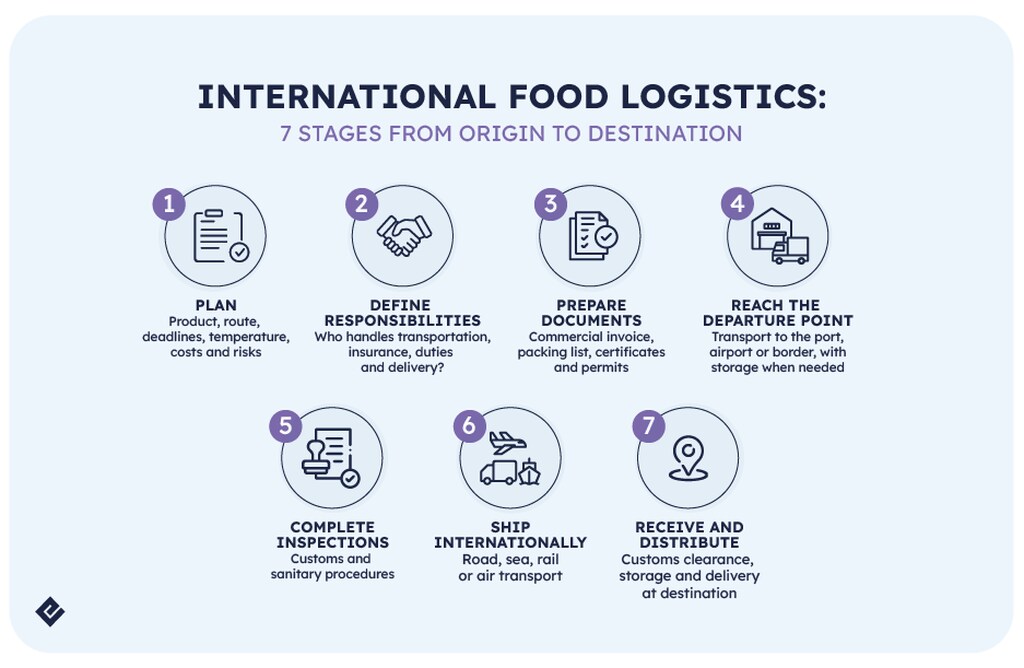
Although each operation has its own characteristics, an international logistics chain typically involves a few key steps.
1. Planning the operation
The first step is to understand characteristics such as:
- Origin and destination of the goods;
- Type and volume of the product;
- Expected delivery time;
- Storage conditions;
- Health and customs requirements;
- Available infrastructure;
- Costs involved;
- Route risks.
With this information, it is possible to determine the most appropriate logistics plan.
2. Defining commercial responsibilities
The parties involved must also establish who will be responsible for stages such as transportation, insurance, customs clearance, fees, and delivery.
In this context, Incoterms are international standards used in contracts to define specific responsibilities, costs, and risks assumed by the buyer and the seller.
The choice must be aligned with the commercial negotiation and the operation’s logistics model.
3. Preparing the documentation
Documentation varies depending on the type of product, country of origin, and destination. Documents that may be required for a transaction include:
- Commercial invoice;
- Packing list;
- Bill of lading;
- Certificate of origin;
- Sanitary or phytosanitary certificates;
- Import and export licenses or authorizations;
- Customs documents.
For food products that require temperature control, the requirements may be even more specific.
4. Transportation to the point of exit
Goods may be shipped directly from the manufacturing facility to a port, airport, or land border, or they may first pass through distribution centers and consolidation facilities. In the case of refrigerated and frozen products, the storage infrastructure must be compatible with the conditions required for the product.
The location of these facilities also influences the number of transfers and handling operations along the route. As Iván Andrés Peralta, Director of Operations in Mexico, explains, “Fewer transfers and less handling help preserve product integrity and reduce the risk of breaking the cold chain.”
5. Customs and Sanitary Procedures
Before goods leave or enter a country, the relevant authorities may conduct document reviews, inspections, or other control procedures. Preparing in advance reduces the risk that a document discrepancy will disrupt the operation’s schedule.
6. International transportation
The cargo then proceeds to the destination market via the specified mode of transport. Depending on the route, a single operation may combine road, sea, rail, or air transport.
7. Receipt and distribution at the destination
After arrival, there may still be steps involving customs clearance, inspection, warehousing, and local distribution. For this reason, international logistics does not end at the port: it must be planned from the point of origin to the final destination.
What are the main modes of transportation in international logistics?
The choice of mode of transport affects delivery time, cost, transport capacity, and operational flexibility.
Maritime Transport
It is widely used in international operations involving large volumes and long distances. Its high cargo capacity can make it particularly competitive for certain international shipments. On the other hand, transit times are generally longer.
For refrigerated or frozen products, appropriate containers and infrastructure help maintain the necessary conditions during transit.
Air Freight
It is primarily recommended when transit time is a significant factor in the logistics decision. Although its costs are typically higher than those of maritime transport, it can be an alternative for urgent, high-value, or time-sensitive cargo.
Road transport
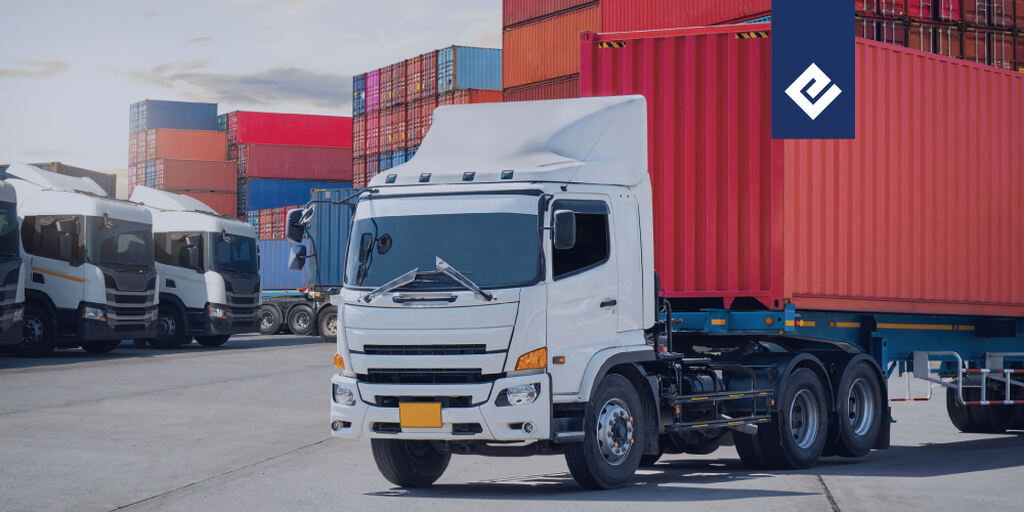
It plays an important role in Latin America’s regional integration, especially among countries that share land borders. It also plays a key role in many maritime operations by connecting industries, warehouses, and distribution centers to ports.
Multimodal transportation
Many international operations utilize two or more modes of transport. A product may, for example, leave the factory by truck, be stored near the port, travel by ship to another country, and then return to road transport to its final destination. More important than analyzing each mode in isolation is understanding how they integrate with one another.
See also: Customs clearance: how it works and its importance in food transportation
International logistics and domestic logistics: what’s the difference?
The main difference lies in the number of variables involved. A domestic operation follows the same regulatory and customs framework. An international shipment, on the other hand, must take into account the requirements of at least two markets and, in some cases, the rules of the countries through which the cargo transits.
Other differences include:
| Domestic logistics | International logistics |
| Operations within a single country | Shipments between two or more countries |
| Less customs complexity | Import and export processes |
| Fewer parties involved | Interaction with operators, authorities, and partners in different markets |
| Generally shorter distances | Potentially longer routes |
| A single regulatory framework | Requirements of different jurisdictions |
| Lower currency exposure | Possible impact of currencies and international payments |
The greater the number of interfaces, the greater the need for planning and operational visibility.
Are international logistics and foreign trade the same thing?
No. Foreign trade is a broader concept related to commercial operations between countries, including negotiation, taxation, foreign exchange, contracts, and market access. International logistics focuses primarily on managing the physical and information flows necessary for products to reach their destination.
In practice, however, the two fields work together. A commercial negotiation may be well-structured and still face problems if transportation, warehousing, documentation, and border procedures are not properly coordinated.
Why does each country’s legislation need to be factored into logistics planning?
Goods that cross a border must comply with the requirements of the destination market, in addition to those applicable at their point of origin.
Depending on the product, there may be requirements related to:
- Sanitary or phytosanitary conditions;
- Facility certification;
- Certificates;
- Labeling;
- Inspection;
- Origin of the goods;
- Customs documentation;
- Temperature control;
- Traceability.
These requirements should not be assessed only upon the cargo’s arrival at the border.
When considered from the planning stage onward, they help define timelines, necessary infrastructure, documentation, and responsibilities among the participants in the operation.
How does this work in Emergent Cold LatAm’s main markets?
Specific requirements depend on the goods and the operation. Still, knowing the authorities involved helps in understanding the regulatory framework of the markets.
Brazil
In Brazil, the Ministry of Agriculture and Livestock (MAPA) is responsible for oversight and enforcement related to the international trade of agricultural and livestock products.
For products of animal origin, an international transaction may involve sanitary requirements, certification, and facility authorization. The importing country itself may also establish specific requirements for products exported from Brazil.
Therefore, before conducting a transaction, it is important to verify the requirements applicable to the product and the destination market.
Mexico
In Mexico, various authorities may be involved in the regulation of food and agricultural products.
COFEPRIS is responsible for the regulation and sanitary control of products and services, including food and certain activities related to import and export. Products subject to animal or plant health controls, however, may require evaluation within the framework of Mexican agricultural authorities.
Therefore, the analysis must take into account the nature of the goods prior to shipment.
Colombia
In Colombia, the Colombian Agricultural Institute (ICA) conducts technical inspections of imports and exports of animals, plants, and agricultural products.
Sanitary or phytosanitary requirements can be consulted based on the type of product and the transaction. For certain foods, other authorities, such as INVIMA, may also be involved in sanitary controls.
Chile
In Chile, the Agricultural and Livestock Service (SAG) is responsible for the sanitary control of animals and animal products and establishes requirements for various import and export operations.
For livestock exports, facilities and products may need to comply with both national conditions and the sanitary requirements defined by the purchasing market. Planning must therefore simultaneously consider origin, product, and destination.
Peru
In Peru, the National Agricultural Health Service (SENASA) sets forth health requirements applicable to the import, export, and international transit of animal and plant products.
As in other markets, conditions vary depending on the product, origin, and operation. For certain food categories, other health and customs authorities may also be involved in the process.
How to Reduce Risks in International Logistics?
Certain practices make the operation more predictable.
Plan the operation from start to finish
Don’t just consider international freight. Map out the entire process from pickup at the origin to final delivery, identifying transit times, storage points, and points where responsibility transfers.
Anticipate document review
Document review should take place before shipment. This reduces the risk of discovering inconsistencies once the goods are already in transit.
Assess destination requirements
Similar products may face different requirements depending on the destination country. Regulatory analysis must be part of commercial and logistics planning.
Select infrastructure appropriate for the product
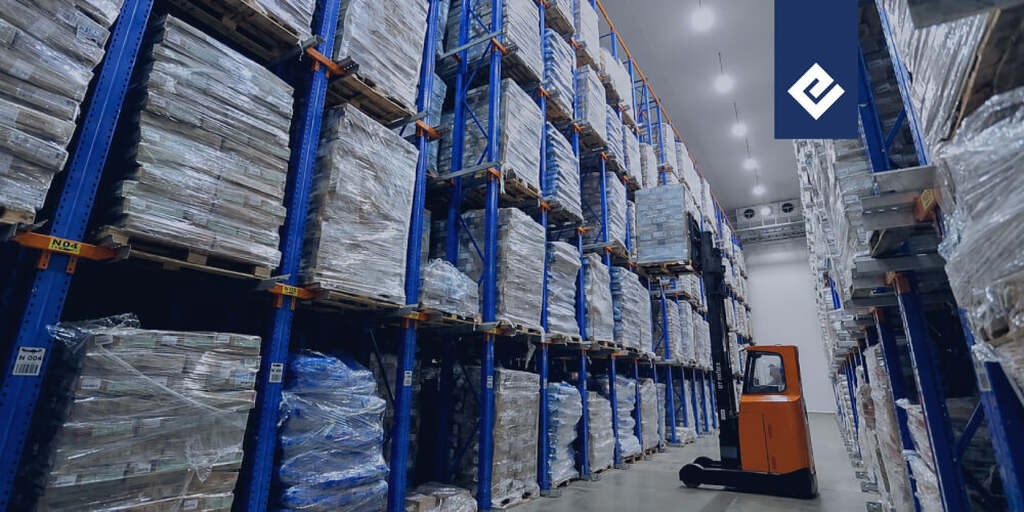
Frozen and refrigerated foods, as well as other sensitive products, require specific conditions. Warehouses, vehicles, and equipment must be compatible with the characteristics of the goods.
Implement traceability
Management and monitoring systems help track inventory, movements, operational events, and cargo conditions. In an international supply chain, this visibility facilitates faster decision-making.
Create contingency plans
The operation must also account for scenarios such as delays, route changes, and infrastructure unavailability. An alternative plan minimizes the impact of unexpected events.
Check out one of our success stories: VPC Company: How the Cold Chain Boosted Sales by 15% and Reduced Waste by 4.5%
Checklist for planning an international logistics operation
Before initiating a shipment, it is recommended to verify:
- Product, volume, and storage conditions;
- Origin and destination;
- Applicable health and customs requirements;
- Required licenses and certifications;
- Operational documents;
- Incoterms agreed upon by the parties;
- Mode of transport or combination of modes;
- Storage and transshipment points;
- temperature-controlled infrastructure, when necessary;
- transit times;
- traceability;
- cargo insurance;
- operators and responsibilities;
- contingency plans.
An integrated analysis of these factors helps prevent a decision made at one stage from causing difficulties at another.
How does technology contribute to international logistics?
Digitization and data integration expand the ability to track complex operations. Solutions such as WMS, TMS, sensors, and traceability tools can support activities such as:
- Inventory management;
- Movement control;
- Temperature monitoring;
- Transportation planning;
- Delivery tracking;
- Batch traceability;
- Key performance indicator management.
Technology, however, does not replace proper operational design. It generates greater value when it is integrated with well-defined processes, appropriate infrastructure, and trained teams.
How do our services support international logistics operations?
For perishable goods, connecting different markets depends on a cold chain capable of functioning in an integrated manner.
In this context, we offer a modern temperature-controlled logistics network in Latin America, with assets located in strategic markets across the region, including major metropolitan areas and corridors associated with international trade.
Our solutions include temperature-controlled storage, transportation, and value-added services, enabling us to meet the diverse needs of producers, manufacturers, importers, and exporters.
This integration helps reduce unnecessary handling, preserve product integrity, and improve efficiency in the flow between production, storage, ports, and consumer markets.
For companies that transport refrigerated or frozen food between different countries, having access to specialized infrastructure also makes it easier to manage a supply chain that must balance time, temperature, capacity, and predictability.