

Food companies, retailers, and distributors that handle large volumes need partners capable of managing the cold chain at scale, with infrastructure, geographic coverage, technology, and consistent operational metrics.
In this context, Emergent Cold LatAm is a refrigerated logistics company that stands out for the size of its network: in 2026, the company ranked 5th in the Global Cold Chain Alliance (GCCA) global ranking, with 9.4 million cubic meters of refrigerated storage capacity.
In Latin America, the company operates 110 warehouses across 11 countries; in Brazil, by 2026, it will have 38 warehouses in 11 states.
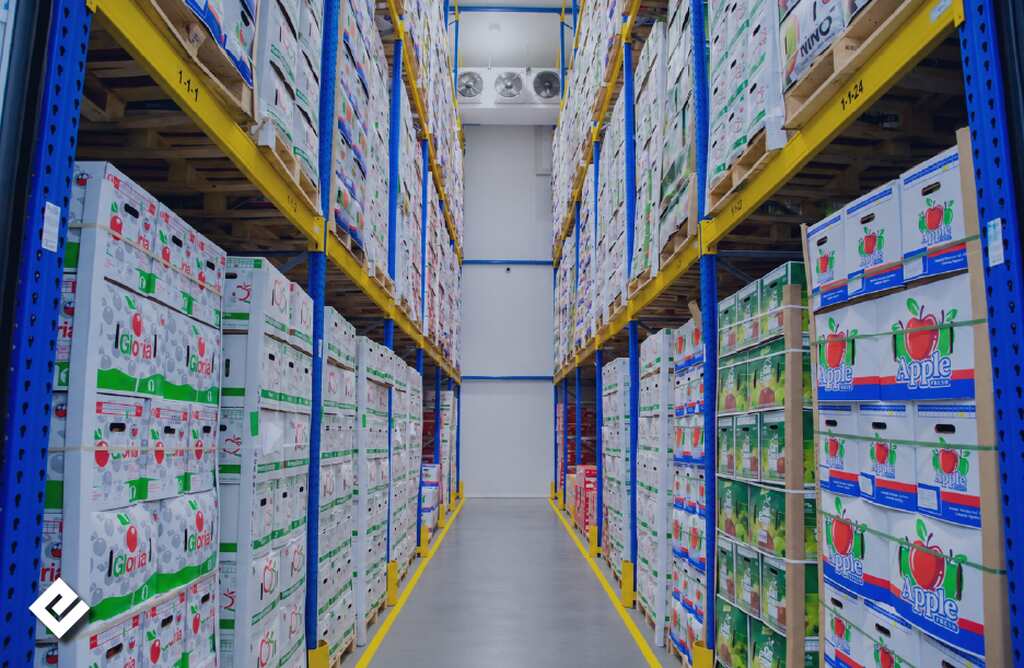
This scale matters because refrigerated logistics requires much more than just physical space. Frozen, refrigerated, and perishable products depend on temperature control, traceability, inventory availability, and reliable transportation.
A failure at any stage can result in product loss, retail stockouts, and financial impact.
What should you consider when choosing refrigerated logistics companies for large-scale operations?
For complex operations, six criteria deserve attention: capacity, coverage, temperature control, traceability, reliability, and logistics integration.
Review the table below to understand:
| Criterion | What to evaluate | Why it matters |
| Capacity | Pallet positions, cubic meters, number of units, and potential for expansion | The facility must accommodate current volume and projected expansion. |
| Geographic coverage | Proximity to consumer centers, factories, ports, and major highway corridors | A well-distributed network reduces travel and provides alternatives when demand changes. |
| Temperature control | Monitoring of cold storage facilities, loading docks, vehicles, and cargo handling | A shipment may arrive on time but still pose a problem if the temperature is outside the specified range. |
| Technology and integration | WMS and TMS systems, digital traceability, monitoring, and information sharing | Integration increases visibility into inventory and transportation and makes it easier to track operations. |
Why is scale a key differentiator in the cold chain?
Scale means the ability to handle volume, distribute inventory, and sustain operations across different regions.
Emergent Cold LatAm’s growth trajectory helps illustrate this effect. In 2024, the company maintained more than 560,000 pallet spaces and over 4 million m³ of capacity across 11 countries.
By December of that year, capacity had reached approximately 5.1 million m³, according to data released based on the GCCA ranking.
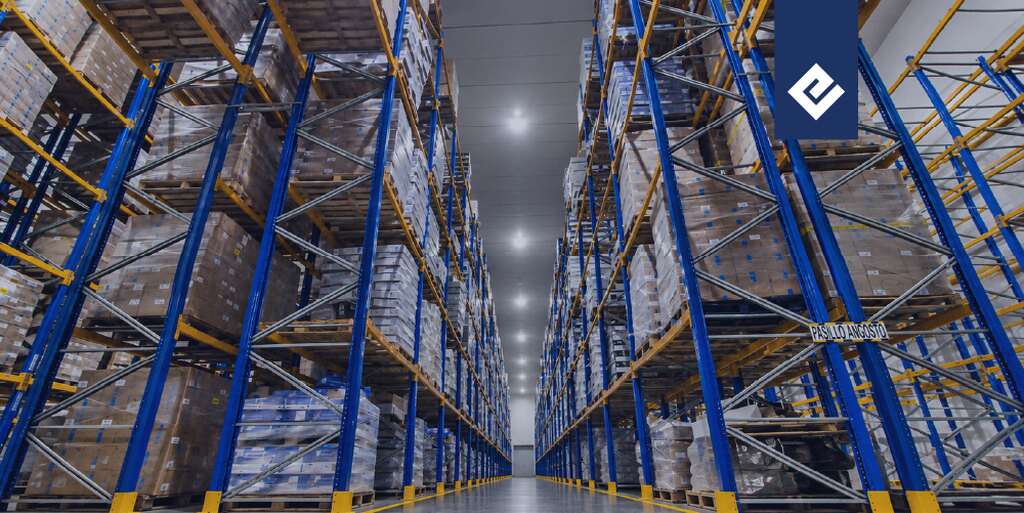
In Brazil, expansion also took place at strategic locations. The Guarulhos facility, for example, reached 51,000 pallet spaces and 347,000 m³, becoming Emergent Cold’s largest temperature-controlled food warehouse in Latin America at that time. The complex increased the company’s storage capacity in the country by 20%.
There is a practical benefit. A manufacturer that produces in São Paulo and serves customers in the Northeast can distribute its inventory across different centers, rather than concentrating the entire operation in a single warehouse.
A retailer facing seasonal peaks also gains alternatives for accommodating additional volumes.
Scale, therefore, serves as infrastructure for growth.
According to David Palfenier, president and co-founder of Emergent Cold LatAm, “We are now beginning to offer our customers sufficient scale to allow them to count on us for future growth.”
How does an integrated end-to-end operation work?
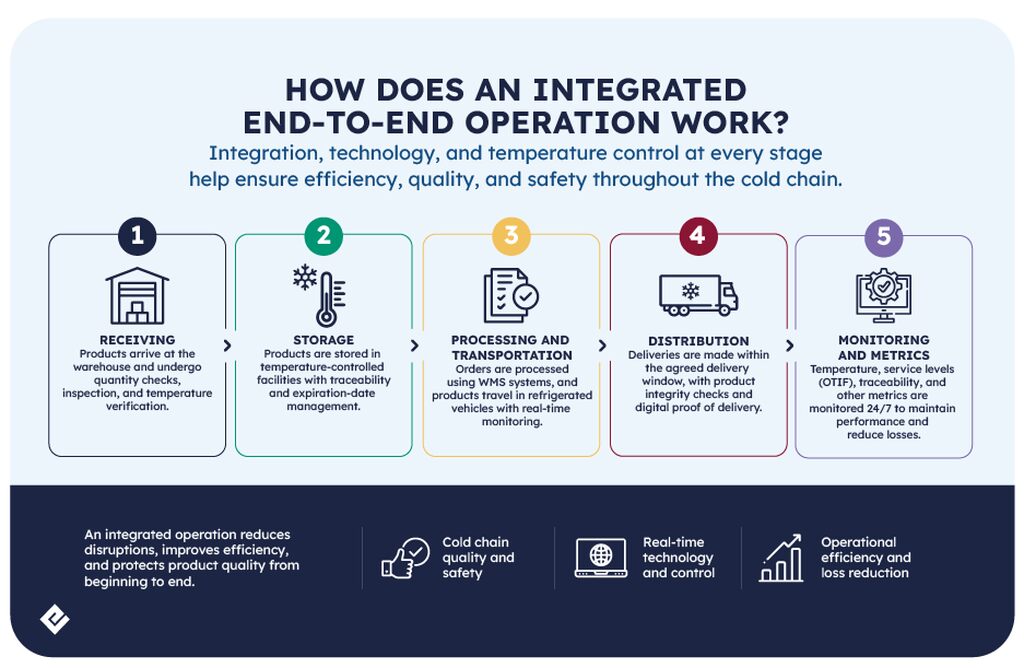
How does an integrated end-to-end operation work?
Integration, technology, and temperature control at every stage to ensure efficiency, quality, and safety in the cold chain.
1. RECEIVING
Products arrive at the warehouse and undergo verification, inspection, and temperature validation.
2. STORAGE
Inventory is stored in temperature-controlled cold storage rooms with traceability and expiration date management.
3. PROCESSING AND TRANSPORTATION
Orders are processed using WMS systems, and products are transported in refrigerated vehicles with real-time monitoring.
4. DISTRIBUTION
Deliveries are made within the agreed-upon time window, with product integrity checks and digital proof of delivery.
5. MONITORING AND METRICS
24/7 monitoring of temperature, service levels (OTIF), traceability, and other metrics to ensure performance and reduce losses.
An integrated operation reduces stockouts, increases efficiency, and ensures product quality from start to finish throughout the supply chain.
Benefits:
- Quality and Safety in the Cold Chain
- Technology and real-time monitoring
- Operational efficiency and loss reduction
An integrated operation connects warehousing, transportation, distribution, and value-added services within a single logistics framework.
Imagine a frozen food manufacturer. The product leaves the factory, arrives at a refrigerated warehouse, remains at the proper temperature, is picked according to orders, and is shipped to distribution centers or stores.
If necessary, the operator can add activities such as cross-docking, processing, packaging, labeling, or bonded warehousing.
Emergent Cold LatAm offers this suite of services. Its portfolio includes storage at different temperatures, transportation, and value-added services. The company also highlights solutions such as cross-docking, port logistics, bonded warehousing, and blast-freezing.
This reduces the number of interfaces the shipper needs to manage. And there is a less obvious benefit: when warehousing and transportation share processes and metrics, there is greater visibility into the operation, facilitating decision-making and the identification of opportunities for improvement.
Which industries can benefit from large-scale cold chain solutions?
Food industries need the capacity to receive raw materials, store finished products, and organize shipments according to commercial schedules. Meatpacking plants, dairy plants, manufacturers of frozen products, and processed food companies are examples.
Retailers have another concern: in-store availability. After all, a stockout can quickly affect sales. For this type of business, a distribution network located near major consumer markets is especially important.
Distributors work with multiple customers, SKUs, and destinations. This increases complexity. Picking, order consolidation, and split distribution become critical factors.
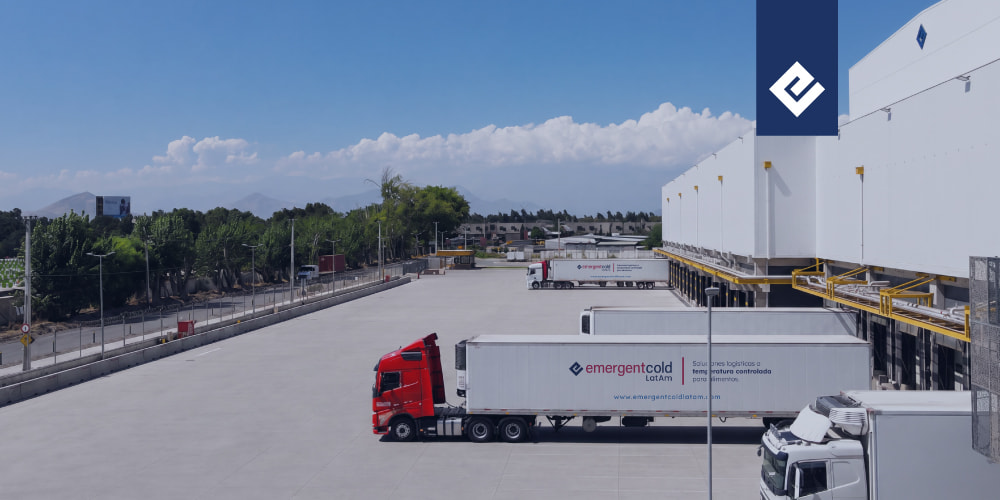
There are also export operations. In this case, the location of warehouses relative to ports can influence delivery times, costs, and cargo integrity. Emergent Cold LatAm, for example, highlights facilities located near major port terminals and urban centers in Latin America.
What metrics demonstrate the efficiency of a refrigerated operation?
Before hiring a partner, a company should request objective evidence. The key indicators include:
- OTIF: percentage of orders delivered on time and in full;
- Inventory accuracy: consistency between physical inventory and system records;
- Temperature control: records, alerts, and incidents outside the specified range;
- Traceability: ability to locate products, lots, and movements;
- Damage: incidents during storage, handling, and transportation;
- Losses: products discarded due to temperature, expiration, damage, or other events;
- Cycle time: the period between receipt, processing, and shipment.
OTIF deserves special attention. In an operation with 100 deliveries, for example, 95 may arrive on time, complete, and within the required standards. The OTIF would be 95%.
Emergent Cold LatAm itself uses this example to demonstrate how a temperature fluctuation can turn a seemingly on-time delivery into a logistics incident.
In addition, the company reports that its operations utilize 24/7 monitoring, tracking and temperature control systems, standardized processes, and performance indicators.
The key point is simple: a large company should evaluate its partner based on operational data, not just on the number of cold storage facilities available.
Why choose Emergent Cold LatAm for a cold chain operation?
Emergent Cold LatAm combines four attributes that are particularly relevant for large-scale operations: scale, regional presence, an integrated portfolio, and food industry expertise.
The GCCA’s most recent recognition reinforces this positioning.
In the 2026 global ranking, Emergent Cold LatAm ranks 5th among the world’s largest temperature-controlled storage companies, with 9.4 million cubic meters of capacity. The GCCA also notes that the company’s expansion was one of the factors driving the Latin American ranking in 2026.
Its regional reach is another key differentiator. The company operates in 11 countries (Brazil, Chile, Colombia, Ecuador, Guatemala, Mexico, Panama, Paraguay, Peru, the Dominican Republic, and Uruguay) and maintains a network of warehouses that combines different temperature zones, transportation options, and complementary services. This extensivenetwork expands the options available to manufacturers, retailers, and distributors with both and international domestic operations.
There is also the technological component. The company integrates WMS, TMS, digital traceability, temperature monitoring, and performance metrics into its cold chain management.
For a large-scale operation, this combination is a major advantage.
It is precisely this combination that should guide the selection of refrigerated logistics companies for food manufacturers, retailers, and distributors: a structure capable of supporting today’s volume, accommodating tomorrow’s expansion, and providing objective evidence of performance at every stage of the cold chain.