


The application of the IoT in logistics is revolutionizing how companies deal with the transport, warehousing and monitoring of perishable foods. In a sector where every minute counts and the quality of the products is a priority, the connectivity between smart devices is a strategic differential.
This technological transformation enables greater visibility, control and efficiency at all stages of the supply chain.
In this article, you will understand how the Internet of Things impacts logistics, especially in the perishable foods sector, exploring its benefits, challenges and practical applications.
What is the IoT and what is its application in the logistics sector?
IoT, an abbreviation for the Internet of Things, is the integration of sensors, software and devices that communicate over the internet, collecting and transmitting data in real time. In the logistics sector, this technology is applied to monitor from the temperature of cargo through to the precise location of a vehicle in transit.
In the case of foods, IoT guarantees that perishable products are transported and warehoused in the ideal quality and safety standards. Thus, companies in the food sector gain greater visibility of their operations and can take decisions based on data quickly.

Principal impacts of the IoT on logistics
From the efficiency of processes to safety in the operations, understand how IoT brings significant benefits to logistics:
Efficiency in processes
The IoT automates tasks that previously depended on manual checks, such as the recording of temperature in cold rooms or the checking of transport routes.
Smart devices send information continuously to centralized systems, enabling managers to accompany everything in an integrated manner. Automation reduces human error, speeds up operations and generates faster, more reliable processes.
Optimization of time and resources
One of the biggest gains of the IoT is in the optimization of time and resources. With location sensors, it is possible to plan deliveries more efficiently, avoiding congested routes and reducing expenditure on fuel.
Besides this, technology helps to prevent the need for maintenance of equipment, avoiding unexpected down time. This integration guarantees better use of the fleet, reduces operational costs and contributes to the sustainability of the sector.
Monitoring goods in real time
In the transport of food, especially refrigerated or frozen ones, maintaining ideal conditions is essential. The IoT allows monitoring in real time of temperature, humidity, and even of the opening of doors to the trucks.
If any parameter deviates from the norm, immediate alerts are sent to the team responsible, who can act before the cargo is compromised. This visibility offers greater reliability in the operations and strengthens the relationship with the clients.
Safety for the operations
Besides increasing efficiency, IoT also improves the safety in the logistics. Sensors installed on vehicles monitor the behavior of the drivers, speed and routes, reducing risks of accidents.
Another important point is the trackability: with precise data on each stage of the journey, it is even easier to identify responsibilities if there are problems, as well as improving the transparency for clients and partners.
Examples of use of the IoT in food logistics
The practical application of the IoT is already a reality in the food sector. Here are some examples:
- Tracking of perishable cargo: fruits, meat and dairy foods can be monitored from the entry to the warehouse and during transport, guaranteeing quality and safety.
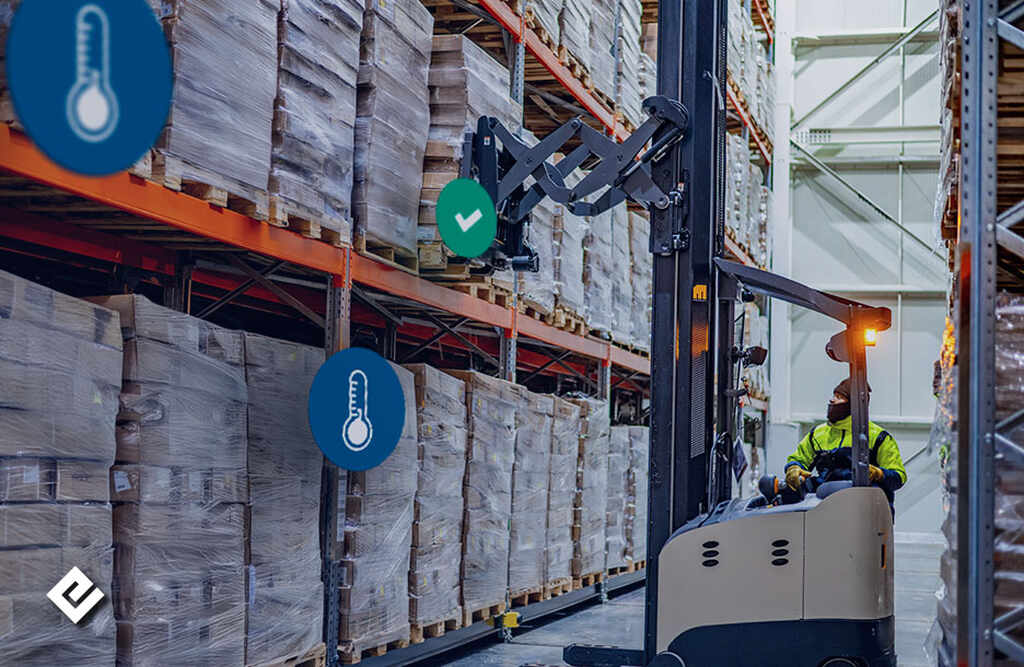
- Control of temperature in real time: sensors in cold rooms and on refrigerated trucks ensure that the products are kept in suitable conditions throughout the whole journey.
- Predictive fleet management: devices installed on vehicles identify wear and anticipate the need for maintenance, avoiding faults and delays.
- Optimization of warehouses: sensors help organize stocks, monitor the validity of products and reduce waste.
- Integration with management software: data collected by the IoT are crossed in smart systems, allowing detailed analyses and better decision making.
These applications not only reduce costs but also increase the reliability and sustainability of the operations, aspects which are increasingly valued in the market.
Challenges to the implementation of the IoT in logistics processes
Despite the countless benefits, implementation of the IoT still faces some challenges. One of the main ones is security of the data, as the information travels over the internet and needs to be protected against unauthorized access.
Another obstacle is the need for robust technological infrastructure, including stable internet networks and systems able to process large volumes of data. Also, the initial investment can be high, requiring planning to guarantee a financial return.
Lastly, the training of teams is fundamental in using the new tools efficiently to make use of the potential of the technology. Given these challenges, the best alternative is to be able to count on a third party logistics partner.
Find out about our solutions for the cold chain
At Emergent Cold LatAm, we understand that technology is essential to raising the quality and safety of logistics of food.
Our solutions for the cold chain use advanced technologies to guarantee that each stage of the process, from warehousing thro to transport, is done with maximum efficiency.
With a modern infrastructure, continuous monitoring and specialized teams, we offer trust and complete visibility to our clients. Whether it is in the trackability of cargo, in the control of temperature or in the management of warehouses, our commitment is to deliver excellence in each detail of the operation.
Conclusion
The IoT in logistics is transforming the way companies manage the food chain, bringing greater efficiency, safety and transparency to the sector.
With the use of connected devices, its is possible to optimize routes, reduce costs, monitor environmental conditions in real time, guaranteeing the integrity of perishable products. The potential of the technology is enormous, especially in Latin America, where the demand for quality food only increases.
Emergent Cold LatAm is ready to help your company make the most of the IoT and to build more agile, sustainable and safer operations.