

Changes in the economic, regulatory and operational environments have changed how logistics chains are designed and managed as of 2026.
At one time these were structured in a few hubs with extended flows, but now these chains have evolved into more regional models, in closer proximity to the markets, with diversification of origins and less dependence on long logistics corridors.
Besides this structural reconfiguration, interruptions at ports, regulatory restrictions, changes to tariffs, extreme climate events and geopolitical tensions have also been causing huge impacts to logistics worldwide.
In this context, the principal logistics trends can orient medium and long term strategic decisions, with a direct impact on efficiency, risk and competitivity.
Below you can find out about the principal trends in logistics transforming the market, above all in Latin America.
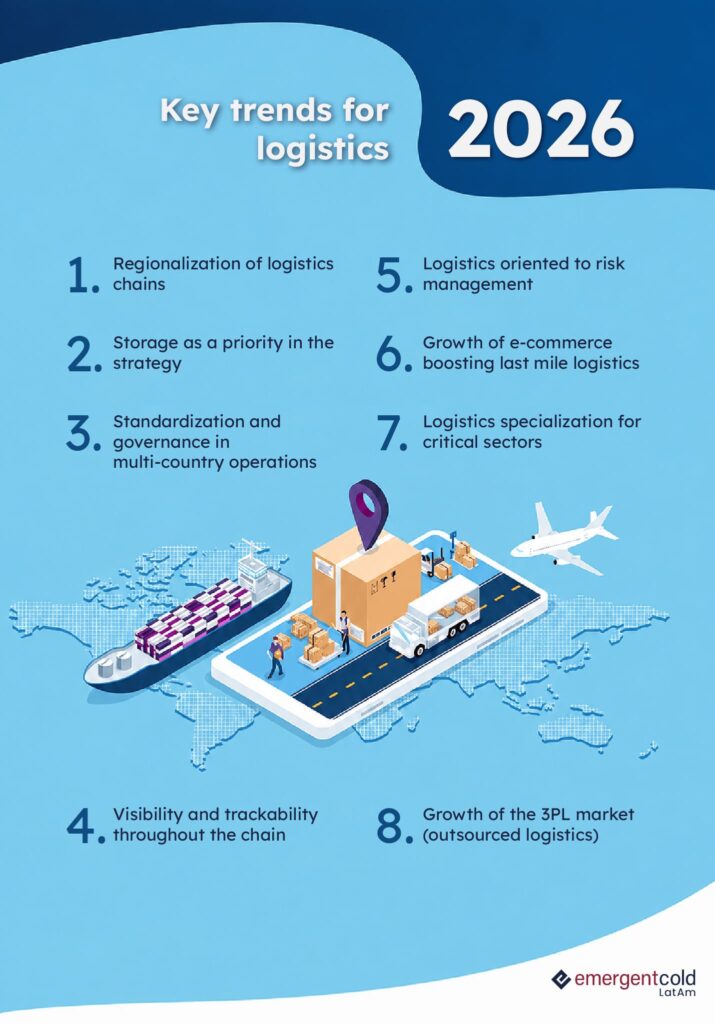
1. Regionalization of logistics chains
The regional strengthening is altering the logistical flows. Long and linear routes are giving way to multiple points of origin, consolidation and distribution.In practice, companies are shortening supply chains and prioritizing production closer to the final markets, a strategy known as nearshoring.
This trend in logistics requires greater coordination between warehouses, integration between modes and the capacity to operate within diverse worldwide standards in different markets.
Thus, complexity increases, and the differential is in the capacity to maintain operational control in fragmented networks.
Practical insight:
In Latin America, this new moment may generate opportunities for the local markets to strengthen their production capacities and to attract foreign investments.

2. Storage as a priority in the strategy
According to a study in The Global Trade Observatory Annual Outlook Report 2026, logistics is no longer seen just as a support, but rather as a competitive advantage.
Decisions about location and capacity are becoming more strategic than ever, molding entire distribution networks, especially in the context of just-in-time logistics and complex supply chains.
Warehouses become strategic assets, essential to determining speed, resilience and access to markets.
Practical insight:
Companies have to plan and invest strategically in warehouses and logistics hubs, guaranteeing faster deliveries, capacity of response to interruptions and better access to markets.
3. Standardization and governance in multi-country operations
Governance in multinational operations is becoming a trend in logistics which requires standardized processes, clear decision structures and mechanisms that work in a multi country context.
Although local, the governance must be able to align with global objectives and guarantee coordination between all the operations.
Practical insight:
Standardization allows companies to operate consistently and in a coordinated manner in multiple countries, reducing errors, whilst aligning local decisions with the global objectives of the organization.
4. Visibility and trackability throughout the chain
The logistics chains are increasingly complex, which increases the demand for visibility from point to point. Operational status, location and critical events make it essential to anticipate divergences and mitigate risks.
In this context, regulations such as the Food Traceability Rule (FSMA 204 – USA), the European Union Deforestation Regulation (EUDR), the Digital Product Passport of the European Union and the regulatory advances in Brazil consolidate a regulatory framework that require trackability, transparency and governance of the logistics chains as of 2026.
Practical insight:
In practice, this scenario reinforces the need to have technically prepared logistics partners, with systems, processes and governance aligned with the new regulatory demands.
5. Logistics oriented to risk management
Logistics is facing various risks — geopolitical, regulatory, climate, operational and even unexpected events, such as energy crises. Given this, it is essential to be able to count on more robust, resilient supply chains less dependent on ideal conditions.
In response, the trend in logistics is to incorporate risk management into the design of the operation. Thus, it is possible to guarantee greater flexibility of routes, alternatives for a more resilient chain and the trust of the market.
Practical insight:
Companies need to redesign their logistics operations considering risk as a certain variable, not as an exception.
6. Growth of e commerce boosting last mile logistics
The electronic commerce of the region is sue to exceed US$ 215 b in 2026, with growth at a higher rate than the global average according to data from the report published by Endeavor and Mercado Livre.
The pressure for ever faster, consistent deliveries and with robust trackability will be a competitive differential for companies in the sector.
Practical insight:
Companies operating with products sensitive to temperature need to migrate from generic logistics models to specialized cold chain structures.
7. Logistics specialization for critical sectors
Chains with requirements for controlled temperature (foods industry, pharmaceuticals, life sciences etc.) continue their growth above the regional average and require dedicated monitoring, IoT and regulatory compliance solutions.
Distributed stocks and specialized hubs for perishables will be increasingly common in markets with variable climate and demand such as Latin America.
Practical insight:
It is better to count on specialized operations that offer continuous monitoring, temperature control and strategic hubs.
8. Growth of the 3PL market (outsourced logistics)
Projections for the outsourcing logistics segment, which includes storage, transport and added value services is due to reach CAGR of 8.5% between 2026 and 2033 in Latin America.
This growth opens up space for specialization of the cold chain services, with greater focus on temperature control, the proper handling of perishable products and on the provision of solutions designed in accordance with the profile and requirements of each type of client.
Practical insight:
It is better to count on logistics operators with practical experience in the cold chain and perishable products.
If you seek a partner specialized in controlled temperature foods, we can help you guarantee efficiency and safety throughout the operation.
How leaders in logistics should prepare
The principal trends in logistics point to more regionalized chains, governed and oriented towards predictability.
In a less linear and more uncertain environment, logistics is consolidating its strategic role in continuity and in the competitivity of businesses.
The competitive advantage is in the capacity to operate with consistency, control and continuous adaptation, given an ever more complex logistics scenario.
How Emergent Cold LatAm works with the logistics trends
Emergent Cold transforms the principal trends of logistics into concrete solutions, enabling operations with greater resilience. We offer:
- Transport, storage and distribution connected to a global network of more than 130 warehouses strategically located in Latin America.
- Local operations under global governance;
- Specialized solutions for foods and products sensitive to the variation in temperature, with services designed according to the needs of each client.
Talk to our team and transform your operations in 2026.